Feng
Shui as an inspiring tool
Predore
doesn't rely on Feng Shui (for sure!). But still this rich
though ambivalent form of Chinese culture could be used to
teach us some lessons regarding a sound and safe urban environment.
Click
here for
our precedent in Shanghai.
Feng
Shui (pronounced Fung Shway) is known as an ancient Chinese
'philosophy', but in modern times it represents a collection
of quasi-scientific theories typically containing a high
astrological content. At best, Feng Shui is a coherent
treatise on the relationship between humans and their environment.
In principle, therefore, Feng Shui could still be used
to examine the relationship between the built environment
and social safety.
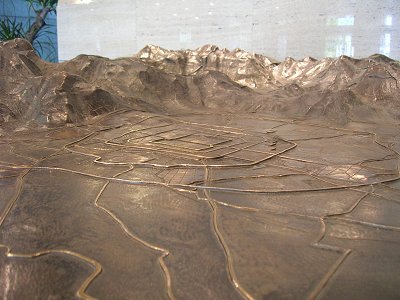
Beijing
in China has a fantastic location. The city lies
on a plain over which rivers flow southwards towards
the Yellow Sea and is
bordered on the northern 'backside' by the mountains and the famous Great
Wall.
Feng Shui principles formed the basis for the urban design of cities
like Beijing. According to Feng Shui, the cardinal direction determines
the orientation of a city, as well as the buildings within that city.
Both a city and a building should preferably be oriented to the south.
From the north, mainly 'bad' winds were expected. |
Feng
Shui in all its variations is primarily applied to make
improvements to the interiors of homes
and offices. Where safety is concerned, Feng Shui is possibly
more relevant in the field of urban planning, namely where
the position of buildings is at stake, particularly the
relationship of those buildings to their surroundings.
Such an application of Feng Shui also does much more justice
to its cultural-historical background, which, after all,
dates back to the practice of Chinese urban planning from
some 3,000 years ago. Feng Shui principles formed the basis
for the urban design of cities such as Beijing. The historical
map of this city shows the vast complex of the 'Forbidden
City,' which forms the centre of a rectangular grid covered
by mountains to the north and oriented towards the south
toward the river basin on which the city is situated. According
to Feng Shui, the cardinal direction determines the orientation
of a city, as well as that of the buildings within that
city.
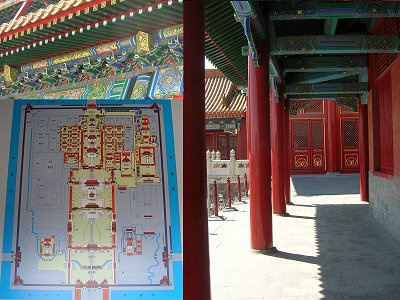
Interior
of the Forbidden City
Inset: map
Both
a city and a building must be oriented to the south, and
thus to the sun; from the north, only 'bad'
winds were expected. However, besides religious or metaphysical
grounds, this principle was also based on climatic and
practical considerations. Good sun exposure is necessary,
as is the availability of water and protection against
wind. Literally, Feng Shui means 'wind and water'.
The 'hutongs', the old working-class neighbourhoods in
Beijing, are therefore predominantly oriented to the south.
The main street is reached from the south, and the residential
alleys leading off that street are oriented east-west.
Most doors are located in facades facing south.
Many astrologically inspired applications of Feng Shui
attribute 'own forces' to each cardinal direction. The
'compass method' is then used to determine these directions.
However, this method is not relevant for applications in
the field of social safety. Incidentally, that applies
to all those forms of Feng Shui if, upon closer examination,
they turn out to be nothing more than variations on astrology.

Click here for
our precedent in Shanghai.
Without
critically discussing the validity of the underlying principles
here, a number of practical rules of thumb can be distilled
from the 'conceptual system' of Feng Shui that largely
correspond to similar rules of thumb in the field of social
safety. The selection may appear arbitrary and incomplete
in the eyes of so-called 'Feng Shui Masters', but that
is precisely the intention. Feng Shui principles are discussed
here only if they are applicable within the domain of Predore.
Principles
 Cities and buildings require a harmonious relationship with
their surroundings.
Cities and buildings require a harmonious relationship with
their surroundings.
Buildings should not stand too close together and must have
protection on the sides and rear.
Buildings possess a solid 'foundation'; that is to say,
the function on the ground floor does not interfere with
the upper floors.
Spaces must have a pleasant atmosphere. The use of colors
can contribute to this.
A transitional area necessarily exists between the private
domain and the public domain. In principle, private space
is never directly connected to public space.
The orientation of entrances is a delicate matter. Traditionally,
a north-facing orientation is unsuitable. The final orientation
depends partly on the previously mentioned rules of thumb.
Entrances are spacious. Natural light is optimally utilized
to enhance spaciousness and visibility.
The urban pattern is clear. The same applies to individual
spaces. Dead corners and spaces that fall outside the regular
field of vision are unfavourable. In general, the intended
use and designed layout of a neighbourhood must have a beneficial
effect on the well-being and health of the residents.
The living and working environment must be clean. Maintenance
must be of a sufficiently high standard.
The immediate residential environment is traffic-calm. Excessive
speeds are countered by the design of the road profile and
road alignment. Fast traffic requires its own designated
area, for example at the edge of the neighbourhood.
Nevertheless,
there are Feng Shui principles that are at odds with the
rules aimed at creating favourable
conditions for social safety. For instance, according to
Feng Shui, greenery can be effectively used to camouflage
certain functions. However, this seems to contradict the
required visibility of those functions. In general, categories
such as police stations, fire stations, cemeteries, and
hospitals are attributed 'negative energy,' and it is advised
to conceal such functions as much as possible and ban them
from living and working environments. This is not only
an incoherent approach to the built environment but, above
all, an extraordinarily counterproductive view when it
comes to guaranteeing social safety as much as possible.

Example
of a handbook: 'Feng Shui in the City: A Practical Handbook
for Modern Urban Living', Singapore 2007. Author: Jason
Fong. "This extensively illustrated book for purchasers
of homes in urban areas has been written by an established
fengshui consultant. Even those who understand little of
the principles involved may benefit from the advice or
guidance offered.", aldus een bespreking (bron:
Internet)
Feng
Shui precedent in Shanghai
On
our vision on Feng Shui, click here...
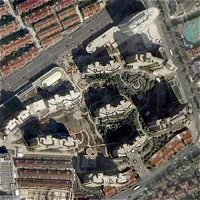
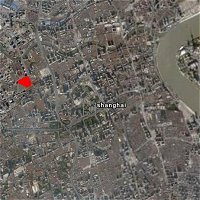
Guoji
Lidu (2002-2005) is a luxury residential complex in the
Jingan district of Shanghai, not far from the city centre.
The main entrance is situated on Beijing West Road. The
project consists of a series of interconnected residential
towers. Various amenities are located at ground level.
A large parking garage is situated beneath the complex.
A significant portion of the site (approximately 40%) is
occupied by a communal garden.
 |

|
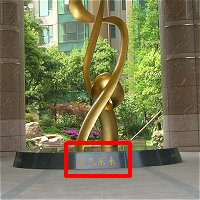
In
the main entrance stands a sculpture whose pedestal is
adorned with the following text, written in
the ancient idiom Pinyin: ‘zi-qi-dong-lai’,
which literally means 'the purple energy comes from the
east', and according to Feng Shui, figuratively, that prosperity
is coming. In modern times, this saying primarily expresses
that happiness and safety are connected to the place of
residence. That is why many Chinese front doors are equipped
with this type of text.
The colour (light) purple dominates the entrance, incorporated
among other things into the natural stone used. Purple
is associated with the dragon (one of the four main animals)
and is therefore considered the 'highest' colour, while
the east as a direction is related to wood (one of the
five elements), which symbolizes life.
In short, everything is interconnected in this entrance.
The 'Feng Shui' is good here. This place is not only safe,
but also pleasant and liveable, or at least that is what
one attempts to express through form, materials, and interior
design. By taking a closer look at a few safety principles
distilled by us from Feng Shui, it can be verified whether
this is indeed the case.
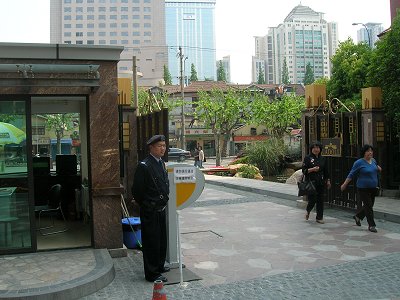
Guarded
main entrance to the site.
Principle:
'A transitional area necessarily exists between the private
domain and the public domain. Private space
is, in principle, never directly connected to public space.'
The guarded entrance is an elaboration of this principle,
but de facto results in a 'gated community'. In terms of
the security of the complex, this is beneficial; for the
social safety of the surrounding area, it is anything but.
The question is also how this military-looking entrance
relates to the following principle: 'Cities and buildings
require a harmonious relationship with their surroundings'.
Collective
entrance to the building complex
Principle:
'Entrances are spacious. Natural light is optimally utilized
to enhance spaciousness and visibility.' This has been
achieved, although we were unable to assess the passageway
for wind nuisance. The transition from the exterior to
the interior (the side facing the communal garden) is pleasant.
Feelings of insecurity seem hardly out of place here. The
text on the plinth (see earlier) makes a strong impression.
It indeed looks prosperous here.
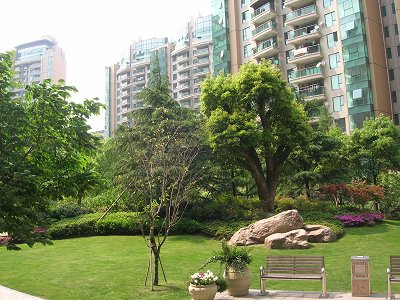
Communal
garden in the inner courtyard of the complex
Principle:
'Spaces must have a pleasant atmosphere. The use of colours
can contribute to this.' Colours have been applied very
carefully in this precedent, particularly a great deal
of light purple, the 'highest' colour. In line with this,
green is also deliberately incorporated. A communal garden
of exceptional quality is practically mandatory in this
type of residential complex, which is naturally beneficial
for the living environment, and consequently for the sense
of safety.

Entrance
to one of the buildings
Principle:
'In general, the intended use and designed layout of a
neighbourhood must have a beneficial effect on the well-being
and health of the residents'. In a luxury residential complex
such as this precedent, this principle is more than realized.
For
our vision on Feng Shui, click here...
For our precedent in Shanghai, click here...
Feng
Shui documentation and precedent were established based
on research by RVDB/Dr.
Rob van der Bijl in Shanghai, with the cooperation of Dr.
Chunlan Zhao (April 2007).
All texts and images:(C) RVDB, Amsterdam, April-October
2007.
Version:
270326






